AI TOOL / #09547
InsertChatGPT
Use your data to build and integrate AI chatbots – without any need for coding.
Introduction
Build and embed AI chatbots using your data without coding.
What is InsertChatGPT?
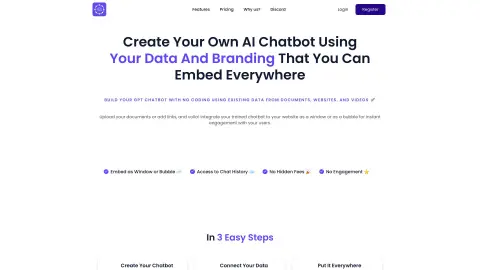
InsertChatGPT enables website owners to offer unique and personalized experiences that go beyond what traditional chatbots can provide. Users can obtain answers to complex questions, engage in natural-language conversations, and receive customized recommendations. This technology allows the creation of GPT chatbots without the need for coding, by utilizing data from existing documents, websites, and videos. Once trained, these chatbots can be integrated into websites as windows or bubbles to facilitate immediate interactions with users.
How to use InsertChatGPT?
Upload documents or add website links to train your chatbot. Then, integrate the chatbot into your website as a window or a pop-up dialog box.
The core functions of InsertChatGPT
Use existing data to create customizable AI chatbots.
Integrated into the website as a window or bubble.
Offers both white-label and themed options.
Access chat history
Use predefined system prompts to customize behavior.
Integration with multiple existing tools
Integrated into the website as a window or bubble.
Offers both white-label and themed options.
Access chat history
Use predefined system prompts to customize behavior.
Integration with multiple existing tools
Related
Flowpoint
AI-based analysis platform identifies website problems and provides conversion optimization suggestions.
BlazeSQL
AI-powered data analysis chatbots and SQL generators suitable for use with SQL databases.
B2B Research AI Agent
An AI-powered B2B research platform with extensive data resources.
Inflectiv.ai
Inflectiv.ai: AI-driven platform for data ownership, verification and monetization, building a decentralized ecosystem.
Sphinx Mind
An AI-powered marketing assistant chatbot that assists with data analysis and campaign optimization.
Secoda AI
A unified data governance platform with AI-driven data catalog, observability, data lineage and governance.